The Hilarious Intersection of Melancholic Pop Culture and Sharp-Witted Stage Presence: Why Invoking the Iconic Emotional Intensity of a Sarah McLachlan Ballad During a Live Comedy Set Creates an Unforgettable Moment of Theatrical Irony, Transforming a Typical Night of Stand-Up Into a Masterclass of Crowd Work, Improvisation, and Shared Nostalgic Laughter for All Involved.
In the high-stakes environment of a comedy club, the most effective weapon in a comedian’s arsenal isn’t always a pre-written punchline; often, it is a well-timed cultural reference that instantly unifies the room. When a performer leans into a moment of mock-tragedy or dramatic flair and remarks that “Sarah McLachlan would be proud,” they are tapping into a specific, shared emotional shorthand. It is a nod to the iconic, heart-wrenching ballads and animal advocacy commercials that have become synonymous with profound, often exaggerated, sentimentality. In the context of a comedy show, this reference serves as a perfect comedic “reset,” allowing the performer to navigate the fine line between the absurd and the poignant.
The beauty of this particular reference lies in its universal recognition. Almost everyone in the audience has a visceral memory associated with those slow-motion montages accompanied by a somber piano melody. By invoking this imagery during a moment of “crowd work”—perhaps when an audience member is sharing a minor hardship or when the room falls into a sympathetic hush—the comedian effectively “punctures” the tension. It transforms a potentially awkward or overly serious interaction into a satirical celebration of melodrama. It is a reminder that in the world of stand-up, nothing is too sacred to be turned into a joke, especially our collective tendency toward sentimentalism.
Improvisation and crowd work are the lifeblood of live comedy, and the “Sarah McLachlan” trope is a masterclass in reading the room. A comedian might use it to mock their own “struggling artist” journey or to playfully tease a patron who looks a bit too somber for a Friday night show. This type of interaction builds an immediate sense of intimacy. The audience feels like they are “in on the joke,” participating in a spontaneous moment of creation that will never be repeated in exactly the same way. It shifts the dynamic from a lecture-style performance to a collaborative social experience, where the performer and the crowd are navigating the emotional landscape together.
From a comedic structure standpoint, this reference functions as a “callback” to a broader cultural identity. It allows the comedian to play with contrast: the grit and edge of a comedy club versus the soft, ethereal polish of a 90s pop ballad. This juxtaposition is inherently funny because it is so unexpected. When a comedian successfully integrates such a specific reference into their set, it demonstrates a high level of mental agility and cultural awareness. It shows that they aren’t just reciting lines, but are actively engaging with the world around them and the specific “vibe” of the audience in front of them.
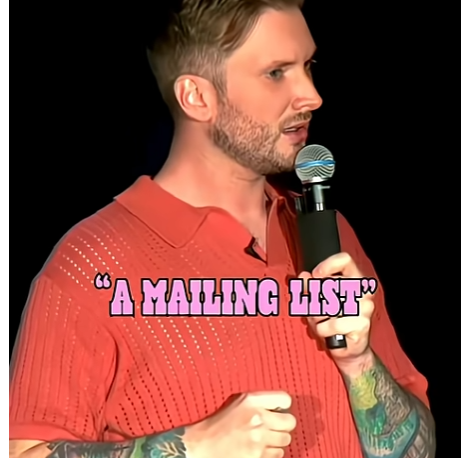
Furthermore, these moments are digital gold for platforms like TikTok and Instagram. Short, punchy clips of crowd work that feature recognizable references tend to go viral because they are instantly relatable. They capture the essence of what makes live performance so special: the unpredictability, the wit, and the shared human experience. A clip captioned with a nod to Sarah McLachlan tells the viewer exactly what kind of humor to expect—smart, observational, and just the right amount of irreverent.
Ultimately, whether the comedian is riffing on a sad story from the front row or lamenting the state of their own career, the goal remains the same: to find the light in the darkness. By invoking the queen of the emotional ballad, they aren’t just making a joke; they are celebrating the fact that even in our most “tragic” moments, there is always room for a laugh.